

Enterprise plan required. Registering Slack workspaces and creating a service account both require the Admin or Security organization role.
When to use it
Company-wide helpdesk agents
An IT or HR agent that everyone in your Slack workspace should be able to ask questions, even the majority of employees who never log in to Gumloop.
Broad rollout without seats
You want Slack-first adoption across hundreds of people without provisioning a Gumloop account for each of them first.
One consistent identity
Every request should hit the same connected accounts and produce the same behavior regardless of who asked, instead of depending on each person’s own connectors.
Not for personal data
Because everyone shares one identity, this is the wrong choice for agents that read the asker’s own mailbox, calendar, or files. Leave those on personal credentials.
How it works
Three things must line up before a person without a Gumloop account can use an agent from Slack:1
The organization has an active service account
A non-human Gumloop identity that Slack-originated requests execute as.
2
Their Slack workspace is registered to your organization
Access is granted per workspace, not per person.
3
The specific agent is opted in
The agent must be shared with the organization and have Allow Slack members without Gumloop accounts turned on.
People who do have a Gumloop account are unaffected. If a Slack user’s email matches a Gumloop account, their request runs on their own account as it always has, even when the toggle is on. The service account is only used for people who have no Gumloop account.
Step 1: Create an organization service account
Go to Settings → Organization → General and find the Service account section, then click Create account.
You get one active service account per organization, and it is the identity for all Slack requests from people without Gumloop accounts, across every opted-in agent.
Restricting what the service account can do
Because every unsigned Slack request executes as this account, it is worth treating it like any other principal you would lock down. Click the service account row to open Manage Access, where you assign Custom Roles that control the apps, tools, scopes, and AI models it may use, plus per-user usage caps. The three-dot menu on the row also lets you copy the service account ID or remove it.
Step 2: Register your Slack workspace
In the same settings page, find Slack workspaces and click Add workspace.
T…), who added it, and when.
You can register multiple workspaces (for example an internal workspace plus a community one). Each is authorized independently, and removing one does not affect the others.
Each section prompts you if the other half is missing: the Slack workspaces card tells you to create a service account, and the service account card tells you to add a workspace. Both must exist before any agent can be opted in.
Step 3: Opt in a specific agent
Open the agent and click Share. Two things are required in this dialog:- Set General Access to Organization.
- Turn on Allow Slack members without Gumloop accounts.

Why Organization and not “Anyone with link”? Public agents are not allowed to carry agent-owned credentials, so they must never inherit the organization service account. The organization-level share is what gates service account execution. If you later switch the agent’s General Access to Anyone, Slack access for people without Gumloop accounts stops working.
Credentials: what the agent can actually touch
This is the part most people get wrong on the first try. The service account is a brand new identity with no connected apps of its own. It cannot borrow the admin’s personal connections, and it cannot borrow the Slack user’s connections either. So for tools to work in a Slack request from someone without a Gumloop account, the agent’s connectors must be set to agent-owned — an account explicitly pinned to the agent, which everyone using the agent acts as. If a connector is left user-owned, the request fails with a message like:1
Open the agent's Connectors and pick the connector
Select the specific account you want the agent to use.
2
Set Credential ownership to Agent-owned
See Agent-Owned Credentials for the full walkthrough. Connectors in this mode show an Agent Owned label in the tool list.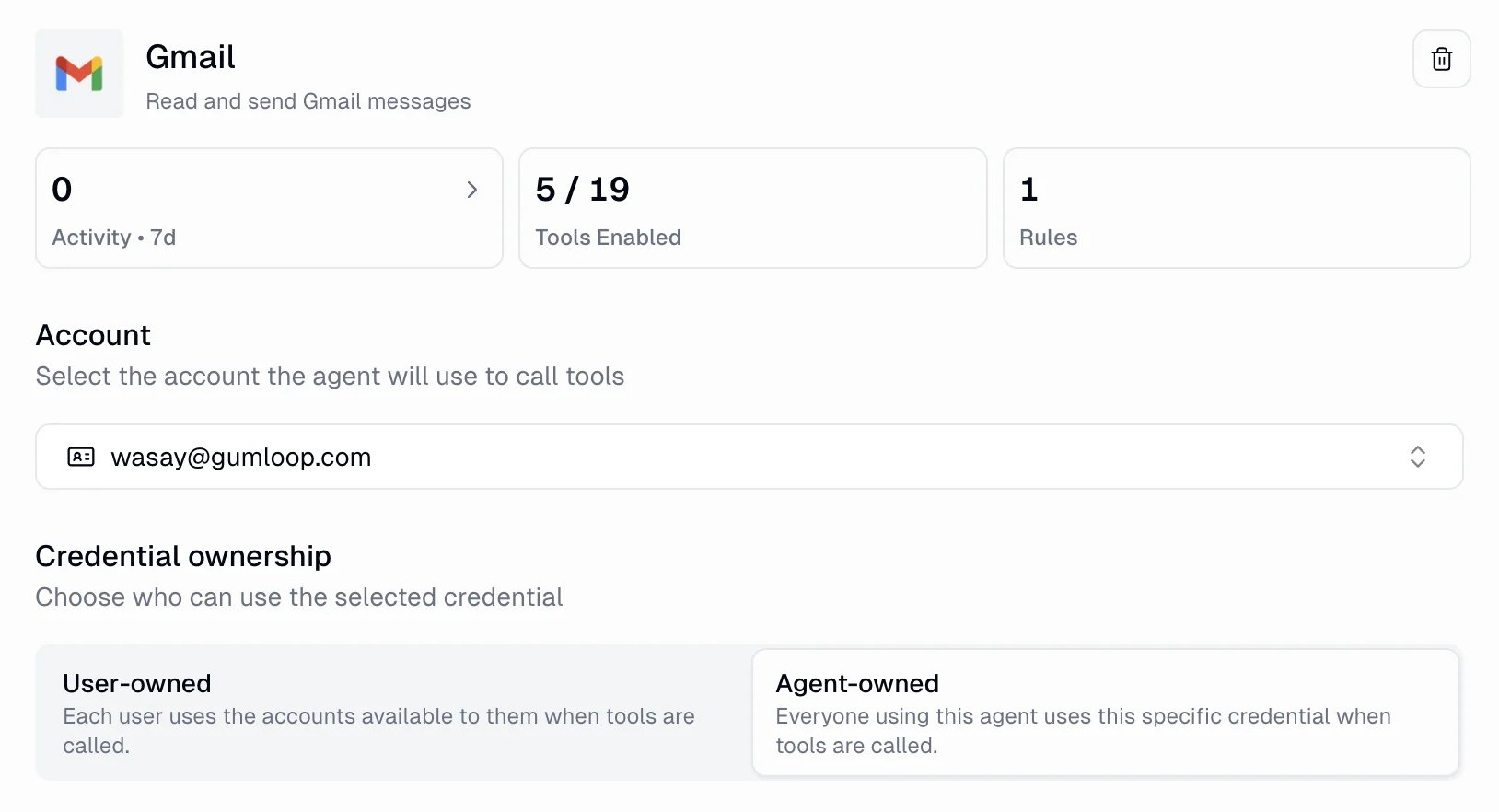
In organizations, agent-owned credentials are restricted by default. If the Agent-owned option is greyed out for you, an admin has to enable the Agent-owned credentials feature toggle on your Custom Role first.
Attribution, credits, and auditing
- Runs execute as the service account. Permissions, Custom Role restrictions, and org policies are all evaluated against the service account, not the Slack person and not the admin who created it.
- The Slack person is still recorded. Each request stores the originating Slack actor (platform, workspace ID, Slack user ID, display name) alongside the conversation, so you can see who actually asked.
- Usage draws on organization credits, not on any individual’s balance.
- Setup changes are audit-logged: service account creation and removal, and Slack workspace registration and removal all emit audit log events.
Who is eligible
Registering a workspace authorizes its full members. The categories below do not receive service-account access. The denial message depends on the configuration:Frequently asked questions
Does everyone in my Slack workspace get access to all my agents?
Does everyone in my Slack workspace get access to all my agents?
No. Registering a workspace grants nothing by itself. Each agent must be individually shared with your organization and individually opted in. The default for every agent, including newly created ones, is off.
Is being in the same Slack Enterprise Grid enough?
Is being in the same Slack Enterprise Grid enough?
No. Authorization is based on the specific Slack workspace ID, so each workspace in a Grid must be registered on its own. If you run a Grid, register every workspace whose members should have access, and verify the behavior for members whose home workspace differs from the one they are posting in.
Whose credentials does the agent use?
Whose credentials does the agent use?
Two separate things. The execution identity is the organization service account, a synthetic non-human Gumloop user. The integration credentials are whatever the agent owner pinned as agent-owned. Never the admin’s personal login, and never the Slack user’s own connected accounts.
A Slack user got the sign-up prompt anyway. Why?
A Slack user got the sign-up prompt anyway. Why?
Work down the list: is the toggle on for that agent; is General Access set to Organization; is their workspace registered (not just another workspace in the same Grid); are they a full member rather than a guest or Slack Connect user; and does an active service account exist. A missing requirement denies service-account access. Slack may show a sign-up prompt, ask an organization admin to finish setup, or ask a workspace member to run the agent.
Slack said 'This agent isn't available yet. Ask a Gumloop organization admin to finish setup.'
Slack said 'This agent isn't available yet. Ask a Gumloop organization admin to finish setup.'
The request could not use a fully configured service-account path. This can happen when the agent is opted in but its service account was removed, or when an active service account exists but the agent is not opted in. Ask an admin to check the registered workspace, active service account, and agent opt-in before retrying.For a full workspace member with no matching Gumloop account, the usual sign-up prompt appears when the agent is not opted in and the organization has no active service account.
What happens to people who already have Gumloop accounts?
What happens to people who already have Gumloop accounts?
Nothing changes for them. Their Slack requests keep running on their own account and their own credentials. The service account path applies only to people with no matching Gumloop account.
Can I revoke access quickly?
Can I revoke access quickly?
Yes, at three levels. Turn off the agent’s toggle to revoke one agent. Remove a Slack workspace to revoke one workspace while leaving others intact. Remove the service account to revoke all unsigned Slack access across the organization at once. All three take effect for subsequent requests; existing conversation history is preserved.
Can I limit what these Slack requests are allowed to do?
Can I limit what these Slack requests are allowed to do?
Yes. Assign the service account a restrictive Custom Role through Manage Access. Since every unsigned Slack request runs as that one account, its Custom Roles are an effective org-wide ceiling on this whole surface. Restricting the agent’s tool list is the other lever.
Do these Slack requests consume credits?
Do these Slack requests consume credits?
Yes, they draw on your organization’s credits, since the service account is an organization member.
Can this be used in DMs with the agent?
Can this be used in DMs with the agent?
No. This feature covers the channels an opted-in agent lives in. DMs to the Gumloop app go to the sender’s own Gumball, which requires a Gumloop account and never runs on the service account — someone without an account gets the sign-up prompt in a DM. See Using Agents in Slack.
Related
Using agents in Slack
Adding agents to channels, Slack preferences, commands, and how credentials work for signed-up users.
Agent-owned credentials
Pin one account to an agent so everyone using it acts as that account. Required for this feature’s tools to work.
Custom roles
Restrict the apps, tools, scopes, and models the service account may use.
Agent access
How General Access rings work, including the Organization level this feature requires.