

Browse your agents
Open agents you own or that others have shared with you.
Build an agent
Create an agent and set its instructions, tools, and access.
Find a task
Search task history across your agents.
Open Gumball
Chat with your personal agent or ask it to reach another agent.
What agents do
Give an agent a goal and the tools it needs. It decides which tools to use and asks you for input when needed.Finding agents
Select Agents in the navigation rail. The panel groups Gumball and your starred agents under Favorites. All shows the other agents you can access. Select Search agents to look up an agent by name.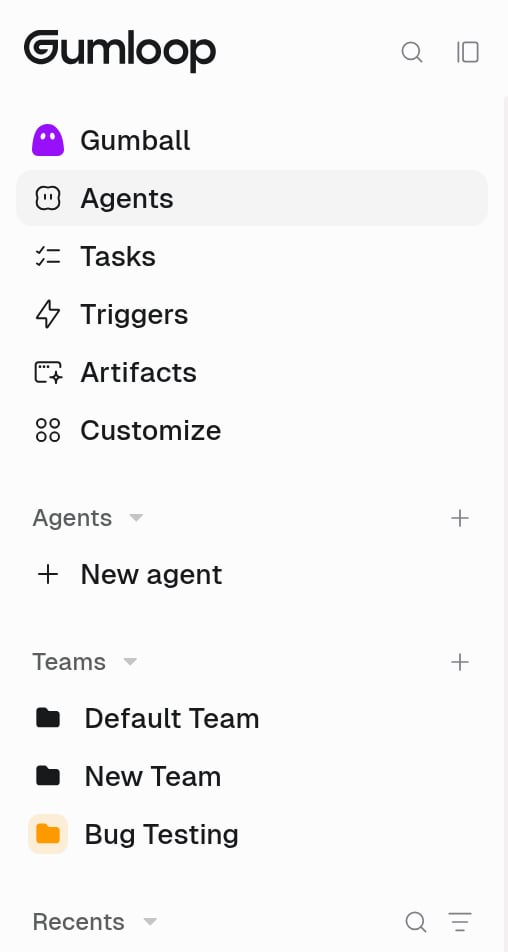
Change the order of agents
Change the order of agents
Select Sort agents beside All, then open Sort and choose Popular, Recently used, or Recently created. Recently created shows agents you created.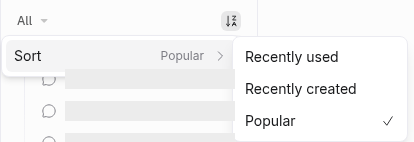
Browse all agents
Select All agents at the bottom of the Agents panel. Use the Teams selector to filter by Personal, a specific team, or Shared with me. The default, All teams, ranks agents by how much you use them.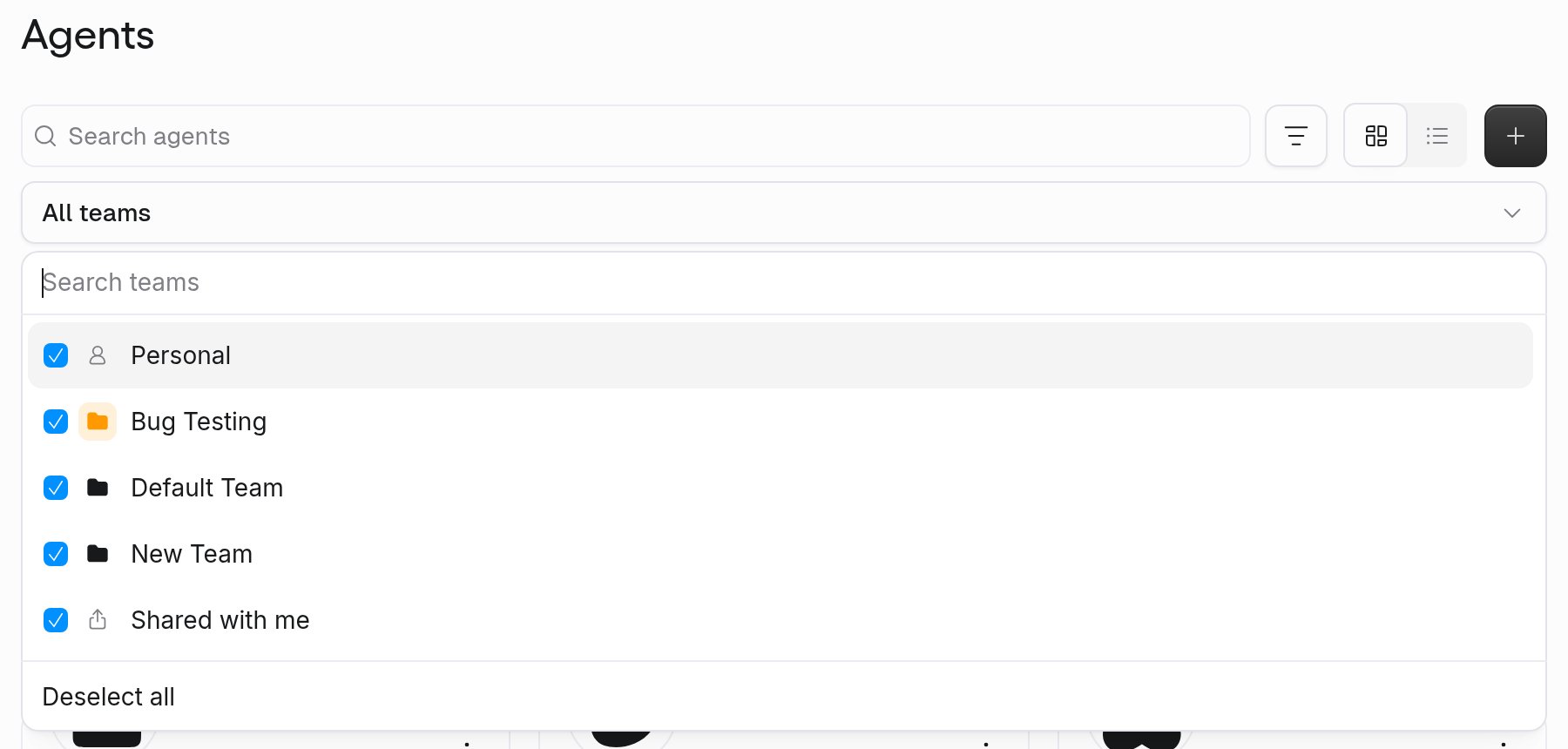
Browse folders or compare agents
Browse folders or compare agents
Select one team or Personal to browse its folders. Use Folder to organize agents. Select several teams to combine their agents in one list. Switch to table view to see the Team and My tasks columns. In card view, each card shows the agent’s connected apps, creator, and last activity.
Keep an agent in Favorites
Keep an agent in Favorites
Select Favorite from its ⋮ menu on the Agents page, or select the star in the agent’s header. Choose Unfavorite to remove it.
Getting around an agent
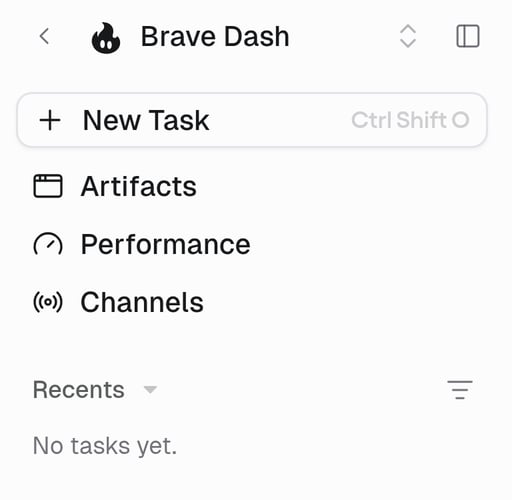
The rail on the far left switches areas. In Agents, the panel next to it lists agents and recent tasks. Your conversation opens in the center, with configuration and task details in tabs on the right.Start or resume a task
- Switch agents
- Start a new task
- Resume a task
Select Agents in the rail, then select an agent from Favorites, All, or Search agents. Send a message to start a task with that agent.
Mention another agent in Gumball
Open Gumball under Agents → Favorites. Type@ in the message box and choose an agent from the suggestions. Tell Gumball what you want that agent to do. Gumball can ask it for help and use its reply in your current conversation. To talk to the agent directly, open it from the Agents panel. See Channels for ways to reach it outside Gumloop.
Work with tabs
Select Toggle configuration in the upper right to show or hide the right panel. Select + (New tab) in the panel’s tab bar and choose a view. You can keep several views open beside the same conversation.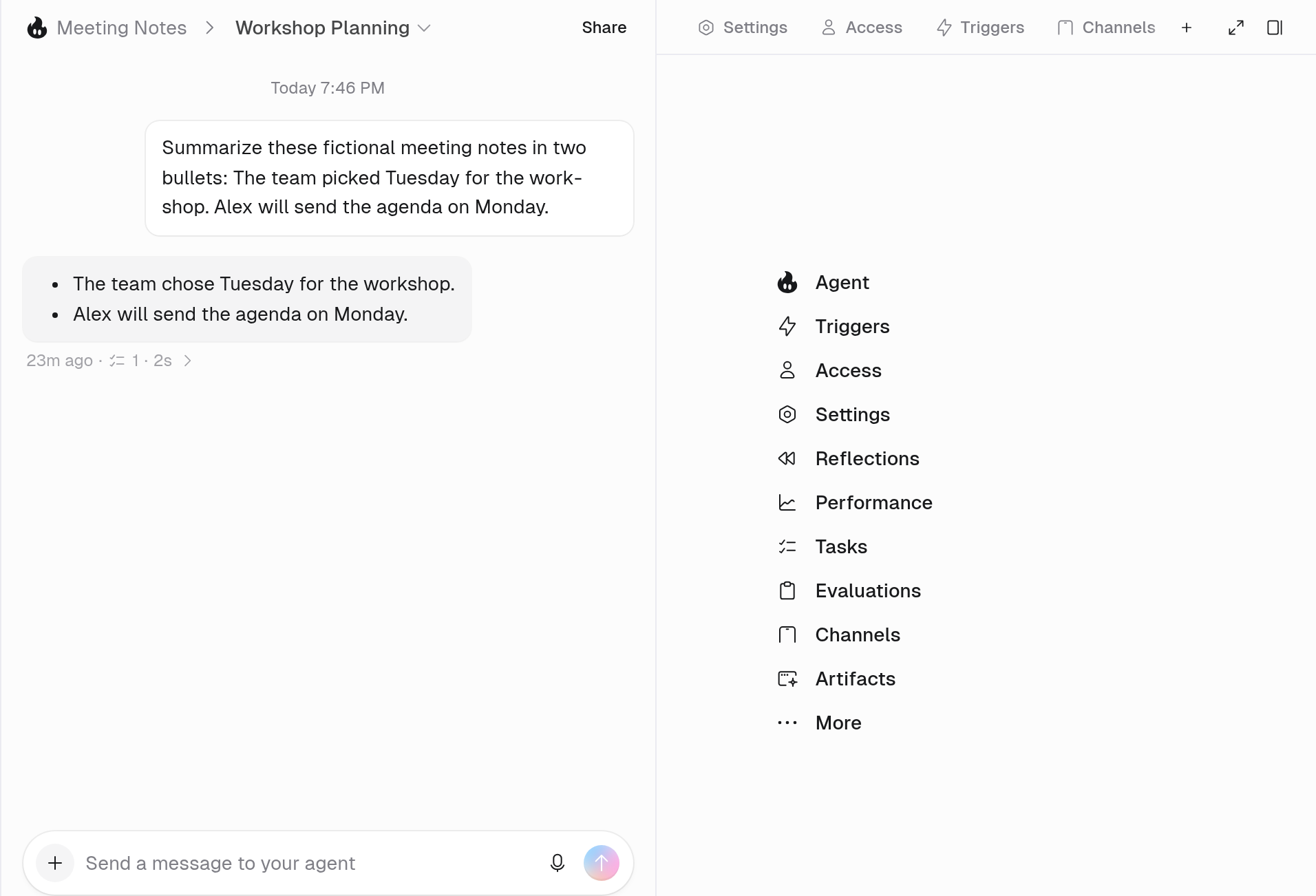
Delete. Drag tabs to reorder them. Expand panel gives the current view more room.
Configuration tabs can stay open as you move between tasks for the same agent. Views tied to a specific conversation, such as Task details, close when you start a new task. Available tabs depend on your agent access and the current task.
Keyboard shortcuts
UseCmd and Option on Mac, or Ctrl and Alt on Windows. The shortcuts for available tabs appear when you hover over their rows in New tab.
When you’re on a custom agent, the command palette searches its tasks and actions. Use Search agents in the Agents panel to switch to a different agent.
Configure an agent in three moves
You do not need to write a long system prompt up front. The fastest way to a useful agent is to let it do real work, then have it write its own instructions.1
Add connectors
Open the Connectors section and add the integrations the agent needs (Gmail, Salesforce, Slack, and so on). The connectors you add define what the agent can see and do, so start with the two or three it actually needs.
2
Give it a real task
Start a task and run something end to end. Watch where it guesses, asks the wrong thing, or misses a step.
3
Ask it to write its own instructions and skills
Once it completes a task the way you want, tell it: “Update your instructions so you always do it this way” or “Turn this into a skill.” The agent writes its own instructions and skills, so you can capture the approach without writing everything from scratch.
The agent builder
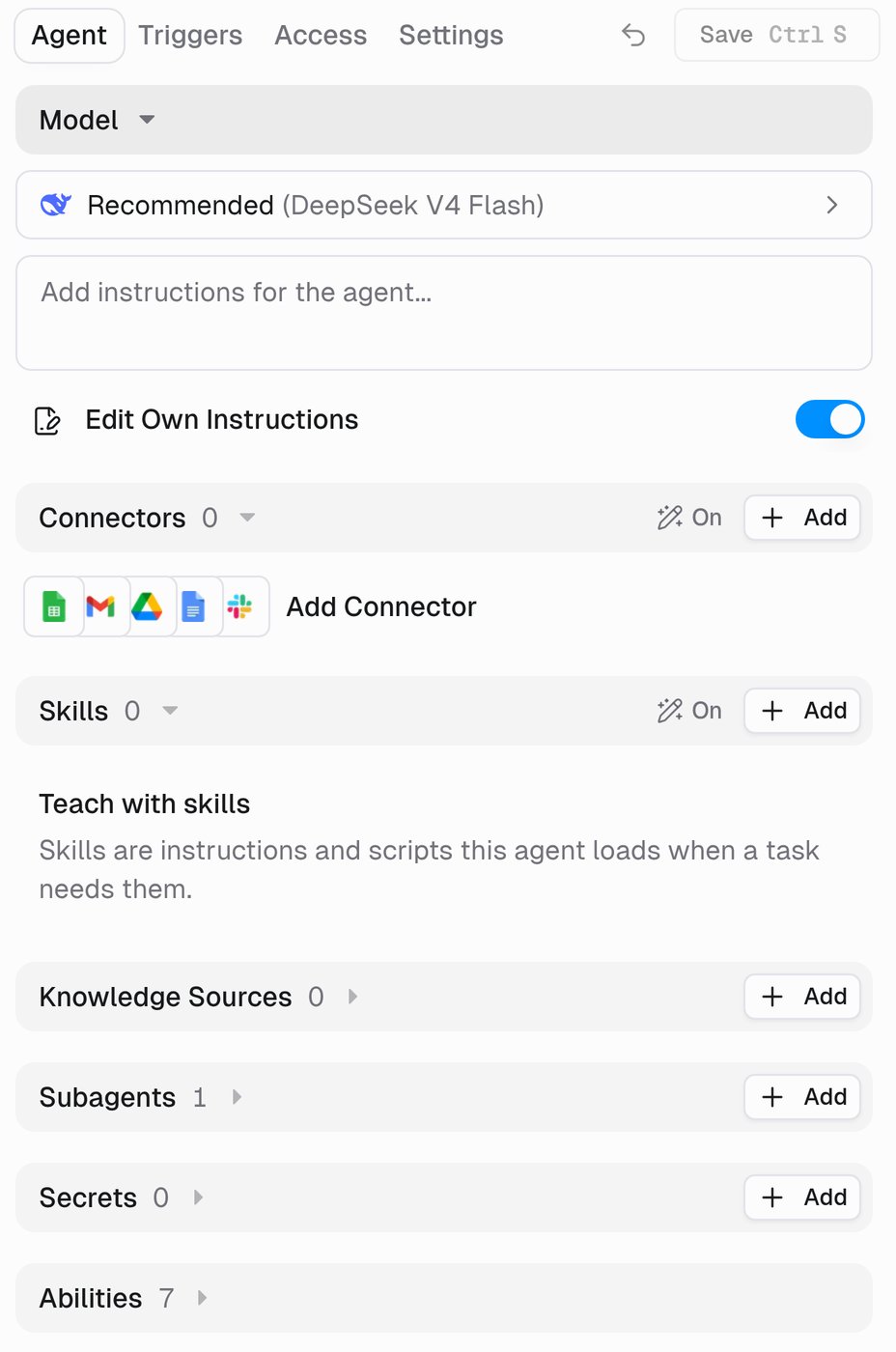
Select New agent in the Agents panel, or Create Agent on the Agents page. Describe what it should take care of, choose a template, or select Setup manually to open the builder. Use + (New tab) in the right panel to open the configuration tabs.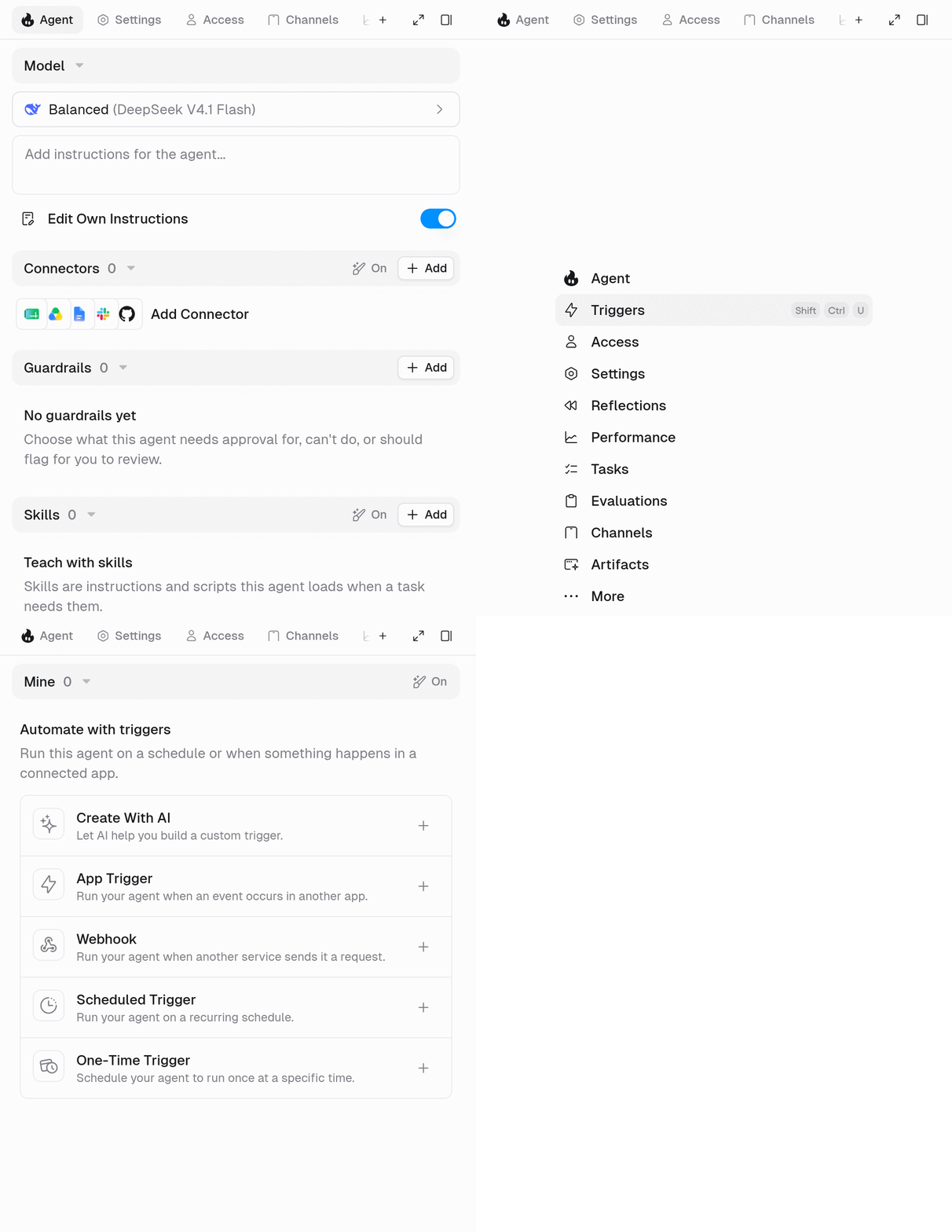
Sections open in place. Click a section header (for example Connectors) and it expands into a full view with an
Agent > Connectors breadcrumb, so you can drill into a connector’s tools and come back without losing your place. Nothing saves until you press Save (Ctrl/Cmd + S); the arrow next to it undoes unsaved changes.
- Agent
- Triggers
Guided setup
A brand-new agent can set itself up from your answer. To open the builder immediately for every new agent, turn on Skip guided agent setup in your profile preferences.Watch how to build your first agent
Watch how to build your first agent
Access
In the right panel, select + (New tab) → Access. Use Owners to give someone permission to manage the agent. Use Who can use to give people or teams access, or to set organization and public link access.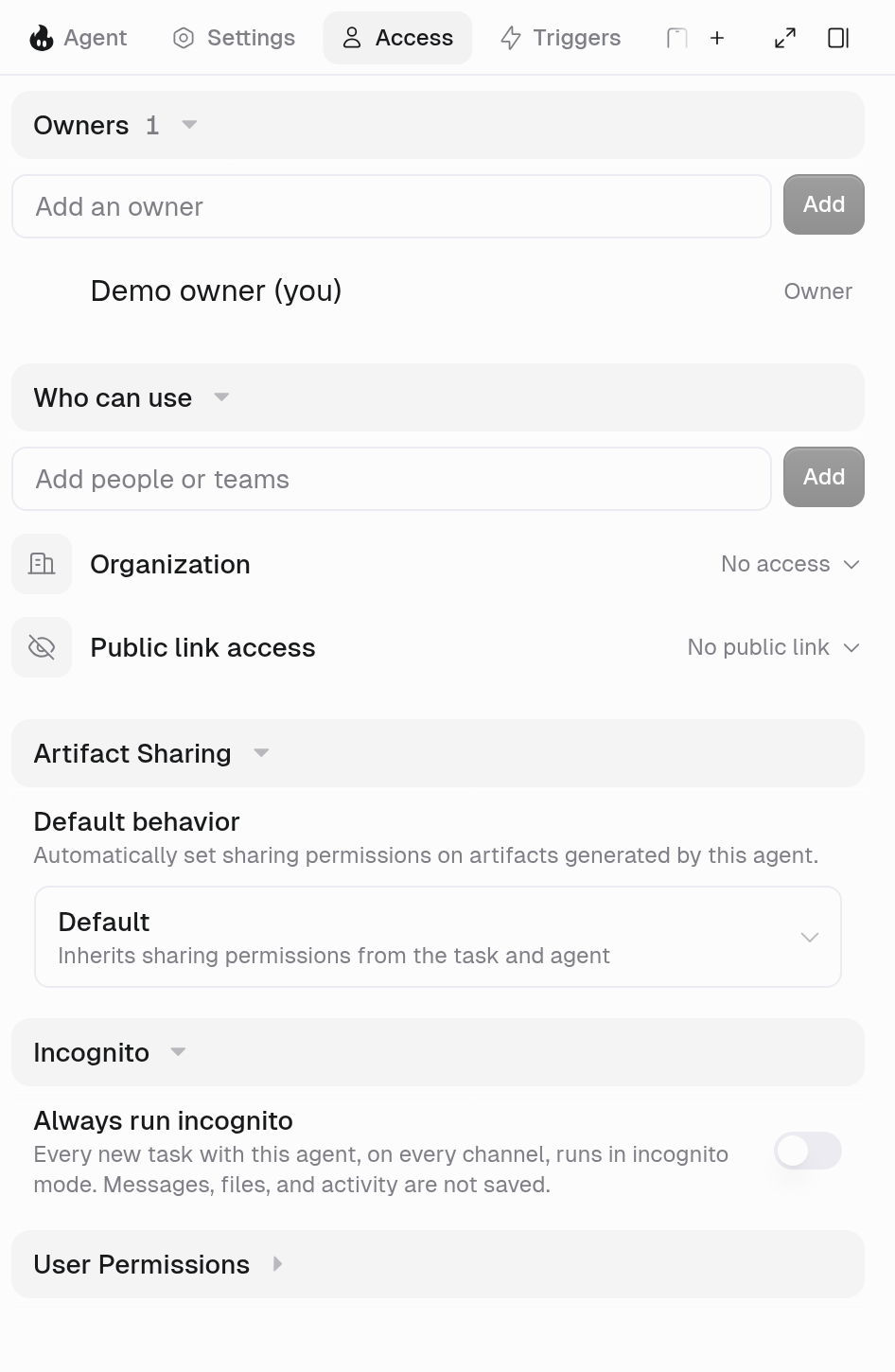
Settings
In the right panel, select + (New tab) → Settings to change how the agent presents itself and how it responds.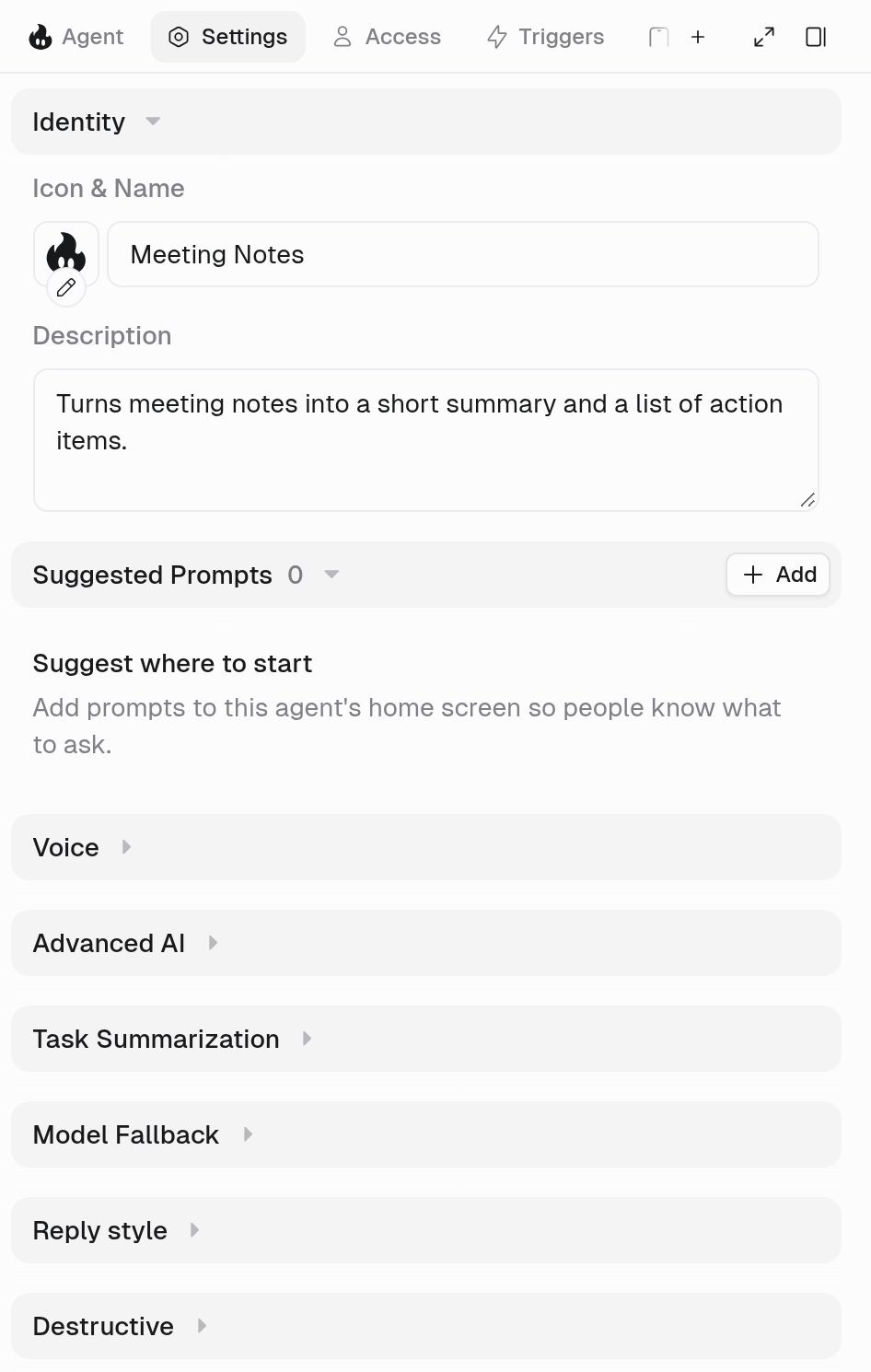
Reply style
Open the agent’s Settings tab, then Reply style:- Relay: shows each step the agent takes, then one final reply.
- Conversational: the agent messages you as it works and keeps its steps tucked away.
Connectors
Connectors are the integrations your agent connects to, such as Gmail, Salesforce, Slack, Notion, and 300+ more. The connectors you add determine what the agent can access, so this is the most important part of configuration.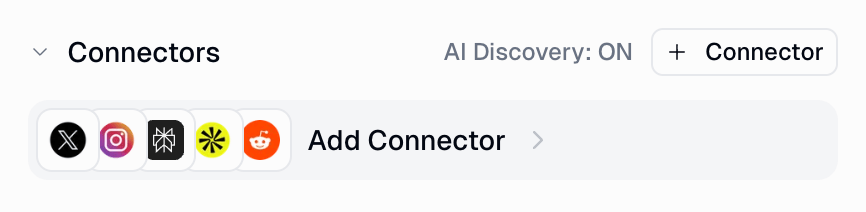
How does the agent use its connectors?
The agent doesn’t load every connector’s tools up front. Each step starts from a small core set of tools, and the agent searches its connectors for the action it needs, then runs it. It loads only the tools it finds, so a step uses fewer tokens and adding connectors adds little to each step. Tool permissions, approvals, and your organization’s connector restrictions apply the same way.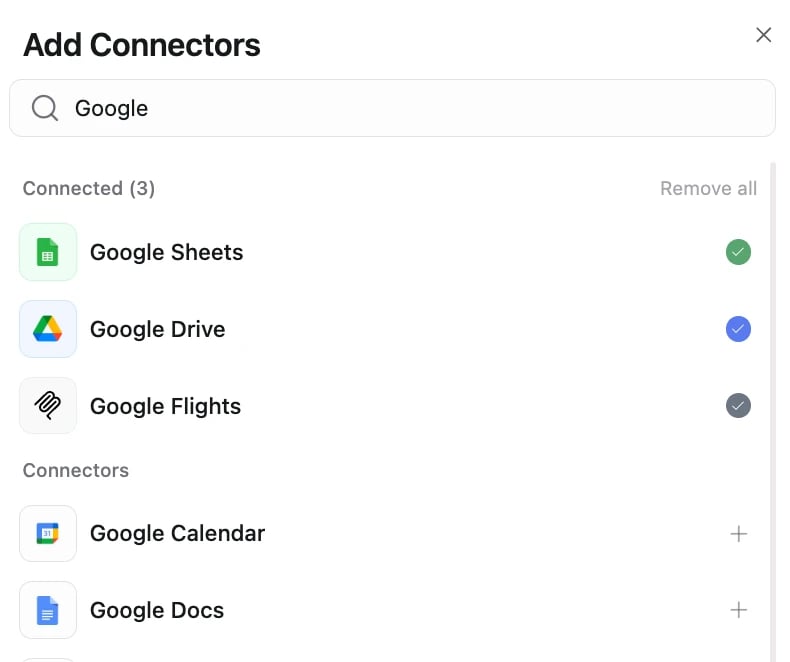
Account selection
Click a connector to open its detail view. Credential and accounts controls whose accounts the agent uses when calling its tools: User-owned (User/Team-owned on team agents) or Agent-owned. Under User-owned, the account selector offers: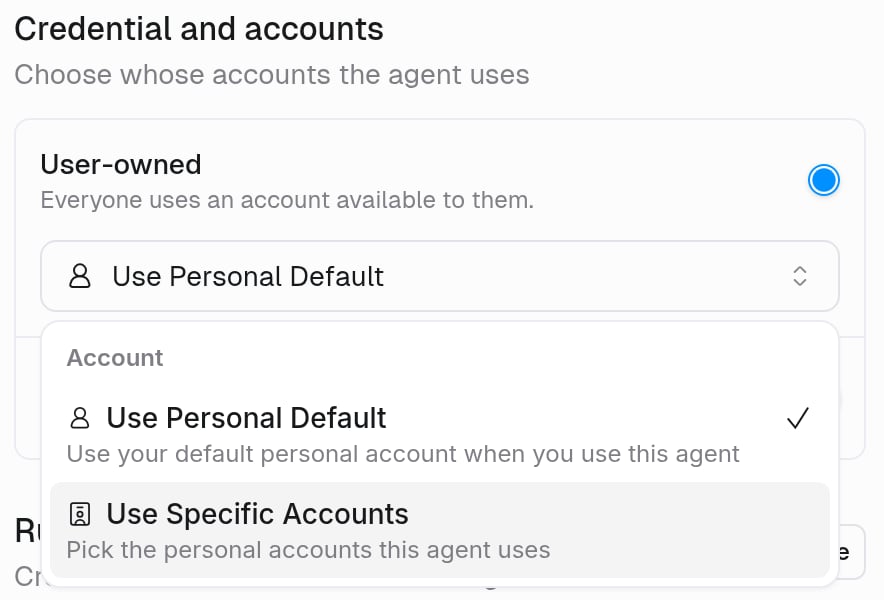
- Use Personal Default: each person who runs the agent uses their own default account. This is the default.
- Use Specific Accounts: pin one or more accounts for the agent. The agent starts with the default account and can pick another pinned account for each call, for example to read from two inboxes. After you choose it, open the accounts selected box to pick the accounts, then Save. Step-by-step: Use more than one account on an agent.
- Use Team Default (team agents only): everyone on the team uses the same shared account.
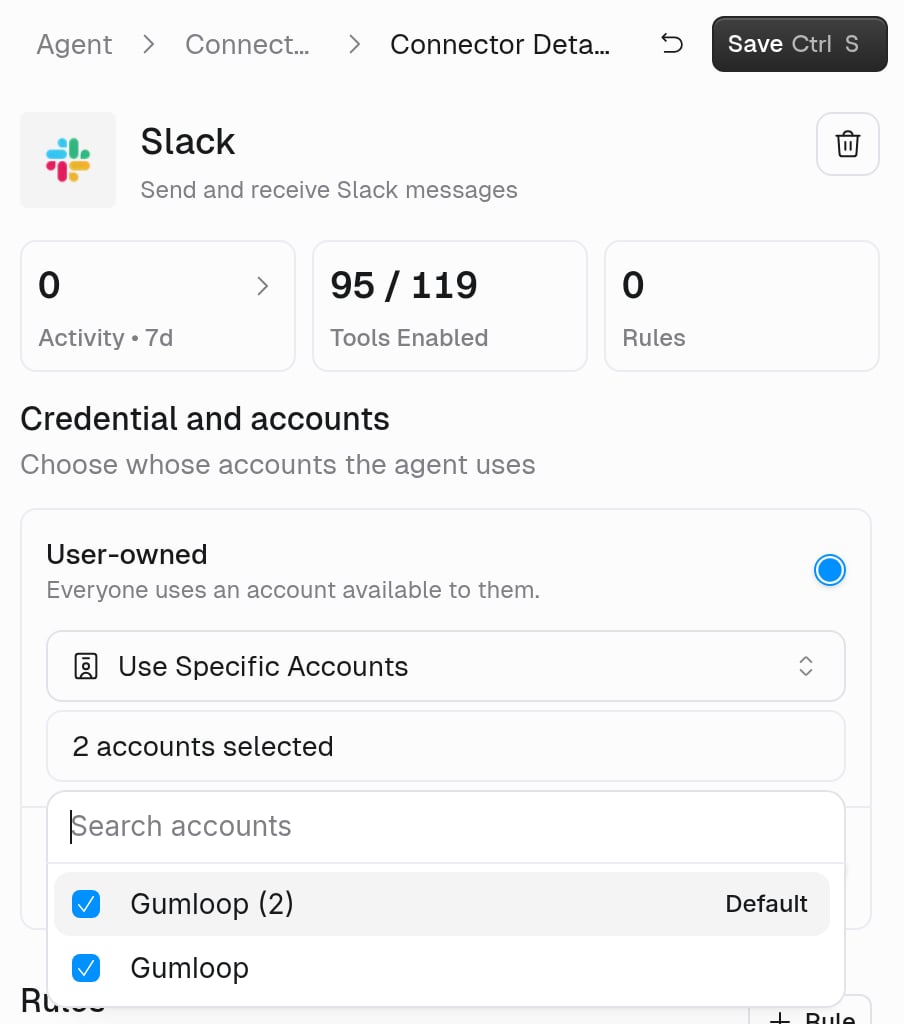
Connectors
Connect personal or team accounts and choose which account the agent uses.
Tool management and approvals
The same detail view has a Tool Management panel that controls which of a connector’s tools the agent can call, and which ones need your approval first. Tools are grouped into Read-only tools and Write/delete tools.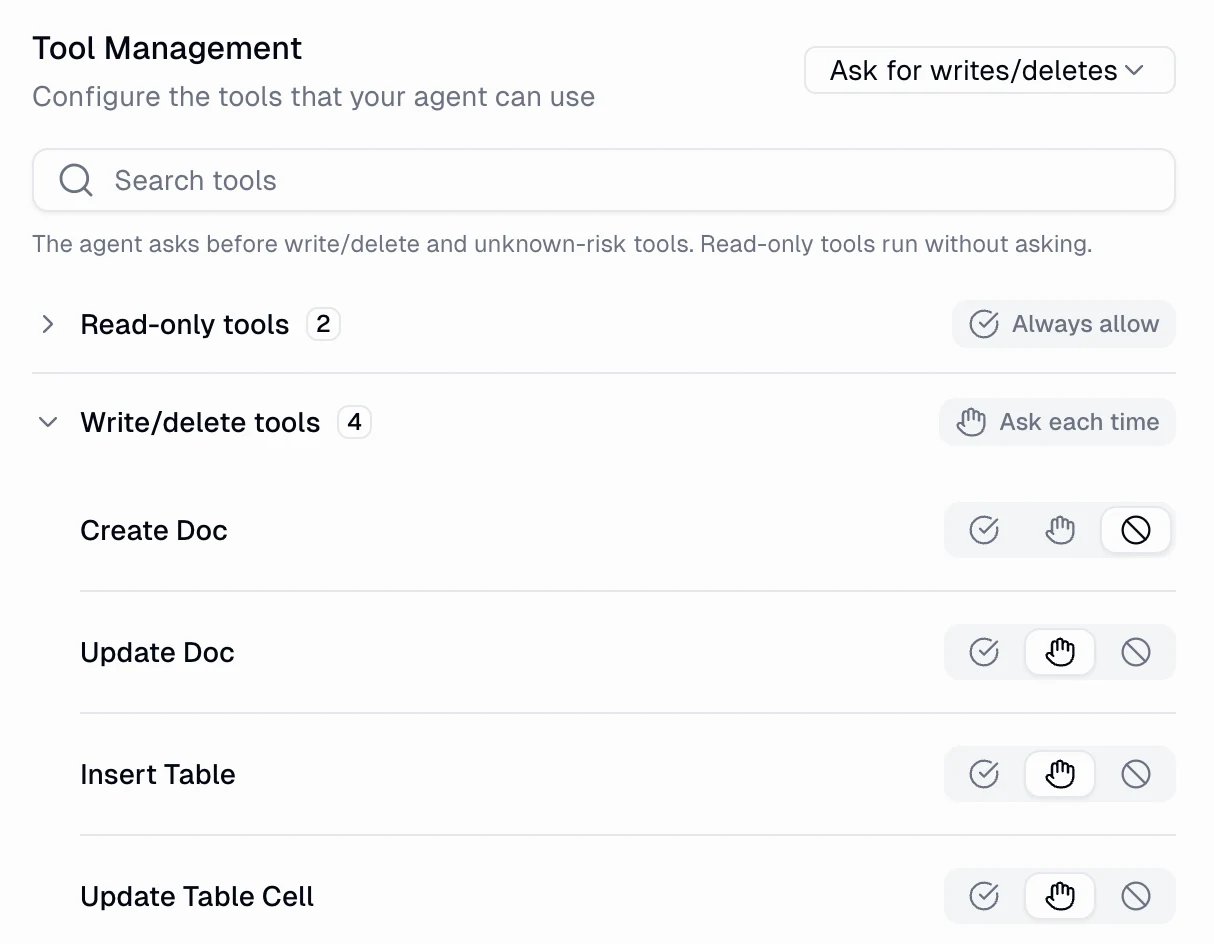
When a tool needs approval, the agent pauses mid-task and shows you an approval card. This is the human-in-the-loop guardrail for sensitive actions.
Human in the Loop
How approvals work, what the agent shows you, and how to tune when it pauses.
Skills
Skills teach your agent how to do specific work your way: multi-step processes, templates, and domain knowledge that load only when relevant. You rarely write one by hand. The easiest path is to prompt the agent in a task: get it to do the work well, then say “turn this into a skill.” When it gets something wrong later, give it feedback and it updates the skill. The AI Skill Editing toggle is what lets it create and edit skills on its own.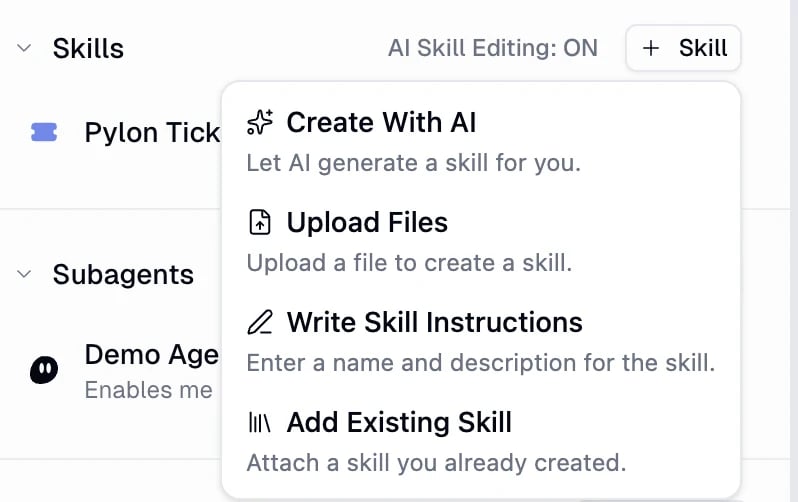
- Create With AI: describe the skill and the agent generates it.
- Upload Files: turn a document or
.zipinto a skill. - Write Skill Instructions: enter a name and description yourself.
- Add Existing Skill: attach a skill you already created.
Agent skills guide
Create skills, attach them to agents, and build a library that improves over time.
Organization defaults and requirements
On Enterprise, organization admins can give custom agents skills and knowledge sources through Settings → Agents → Default Preferences:- Default adds them to new agents. Users can remove them later.
- Required makes them available to every existing and new custom agent. Users can’t remove them.
Knowledge sources
Give your agent a searchable memory of what your company knows. In the Knowledge Sources section, attach Brain sources (Google Drive, Notion, Slack, GitHub, Confluence, or uploaded files) so the agent answers from your real documents and messages, with citations, instead of guessing.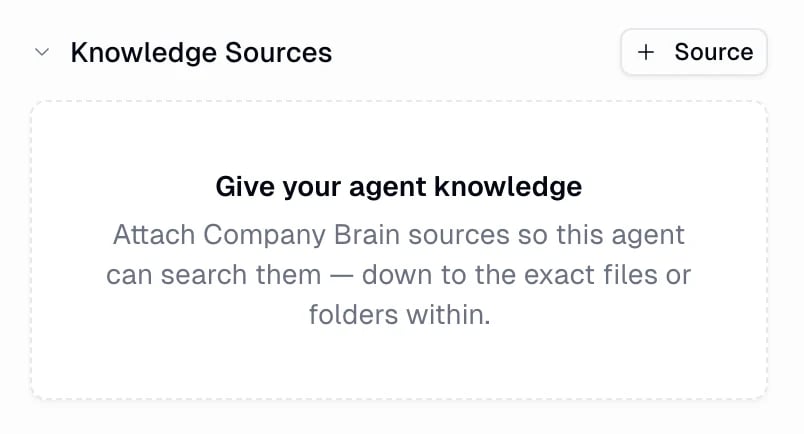
Brain guide
Connect knowledge sources, keep them synced, and give your agents company knowledge to search.
Triggers
Agents can run on their own, without anyone starting a task. Open Triggers from + (New tab) in the agent’s right panel. The magic-wand toggle in the tab header lets the agent create, edit, and manage its own triggers during a task.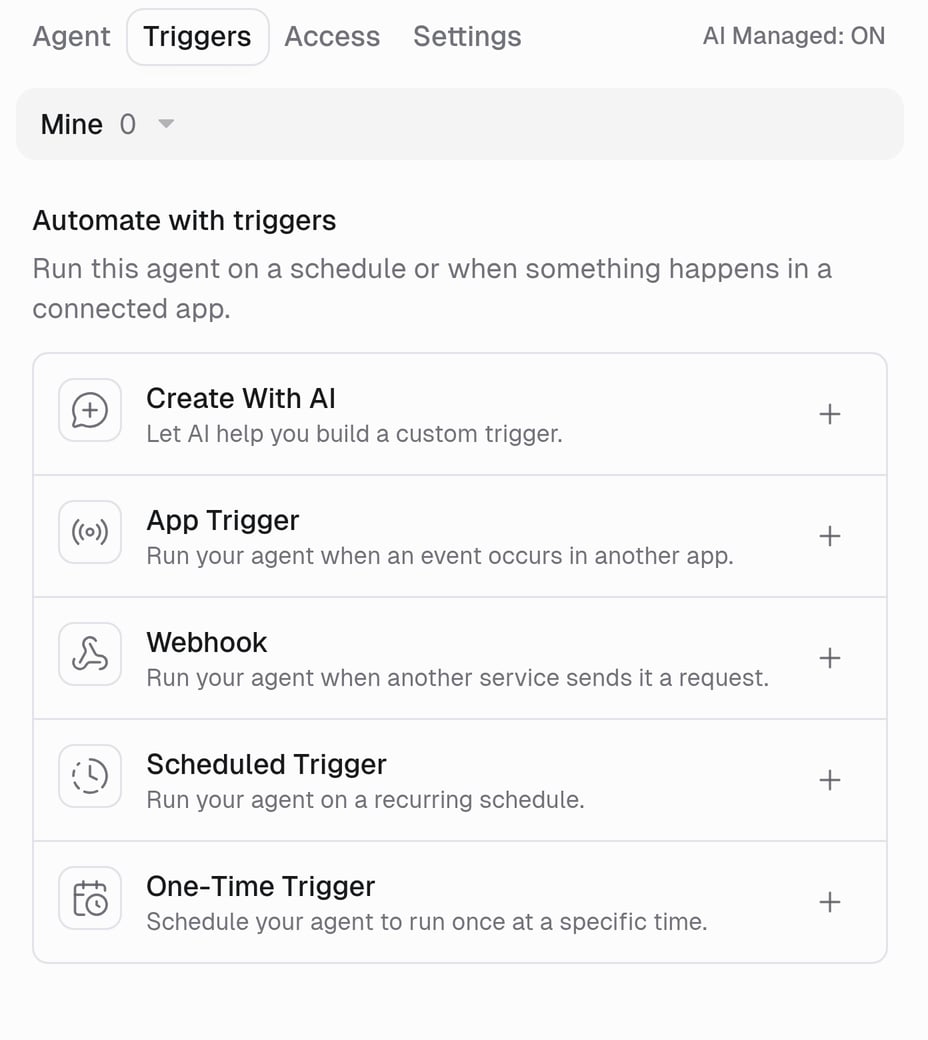
Owners manage every trigger on the agent. Users can create and edit their own triggers while Create triggers is allowed in User Permissions. The Mine / Team filter switches between the two views.
Agent triggers guide
Set up app and scheduled triggers, write prompt templates, and manage active triggers.
Subagents
Subagents let your agent delegate to other agents. Instead of doing everything in one task, it can spin up focused helpers that work in parallel, then collect the results and continue.- Self-cloning
- Invoking other agents
The agent starts copies of itself with the same tools and instructions. Each copy handles a separate part of the work. Self-cloning is enabled by default, and copies cannot make further copies of themselves (a depth limit of 1).
Should you add a subagent or a skill?
For most work, one agent with a skill for each task is simpler than splitting the work across subagents. Each subagent adds a step: your agent has to decide when to delegate, and the subagent still needs a skill to do the work. Use subagents when the work benefits from running in parallel or in batches. Self-cloning handles that without setting up new agents.When do subagent results come back?
In chat, you can ask your agent to:- Wait for results before continuing.
- Keep working while helpers run in the background, then receive their results appended to the agent’s most recent reply. While they run, a pill above the message box reads, for example, 2 subagents working. Open it to see each running helper, select one to open its task, or select View all activity to open the turn that started them. Once the agent finishes its own reply, Waiting for subagents… shows under it until the helpers finish.
- Start independent work without returning results to the original task. Open each helper’s own task to follow its progress.
Can I follow up with a subagent?
Ask your agent to follow up with a helper it started in the same task. A finished helper can continue with its earlier context. If it is still working in the background, it receives the follow-up at a later step. If you stopped the helper, ask your agent to start a new one instead. When Gumball starts a copy of itself, you can ask it to use another model you have access to. This does not change a specialized agent’s own model configuration.How do I see what a subagent does?
In the agent’s Agent tab, select a saved subagent in the Subagents section. Subagent details opens in the side panel with its owner and the Tasks delegated, Credits per task, and Last delegated stats above a daily grid of tasks delegated. Overview shows its Connectors, Skills, and Instructions, read-only. Connectors and Skills preview five items each, with View all to expand their lists. Tasks lists the tasks your agent delegated to it. The arrow button at the top right, Open subagent, opens that agent. If you don’t have access to its setup, you see Setup not shared with you. Subagents can pause for approval, an Ask Question card, or a step, time, or credit checkpoint. Approve the action or choose Continue to resume. Choose Stop to end that subagent’s run. See Human in the Loop.Abilities
Abilities are the agent’s built-in capabilities. Most are on by default, and each can be toggled from the Agent tab’s Abilities section.
Chat Widgets add a compact visual to a live web reply. For a file you want to keep or share, ask the agent to export it. See Agent artifacts (files).
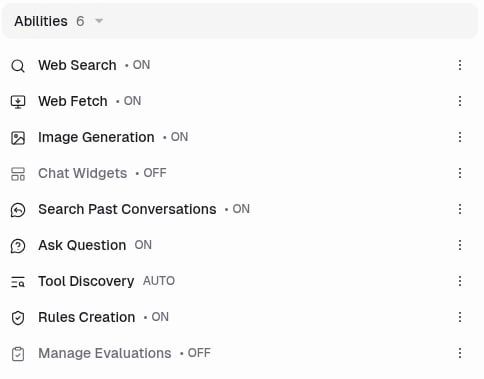
Find Chat Widgets in the Agent tab's Abilities section. This existing agent has the ability off.
Image generation
The Image Generation ability creates images from text prompts. New agents have it on by default and use Recommended: Gumloop picks the model and falls back to another available model when needed. On an agent, you choose the image model. The agent chooses the size, quality, background, format, aspect ratio, and resolution for each request based on the prompt. It is instructed to use the smallest option that satisfies the request.Image models
Open the Image Generation ability’s ⋮ menu to change its Status or Model. Recommended offers the best balance of quality and speed for image generation.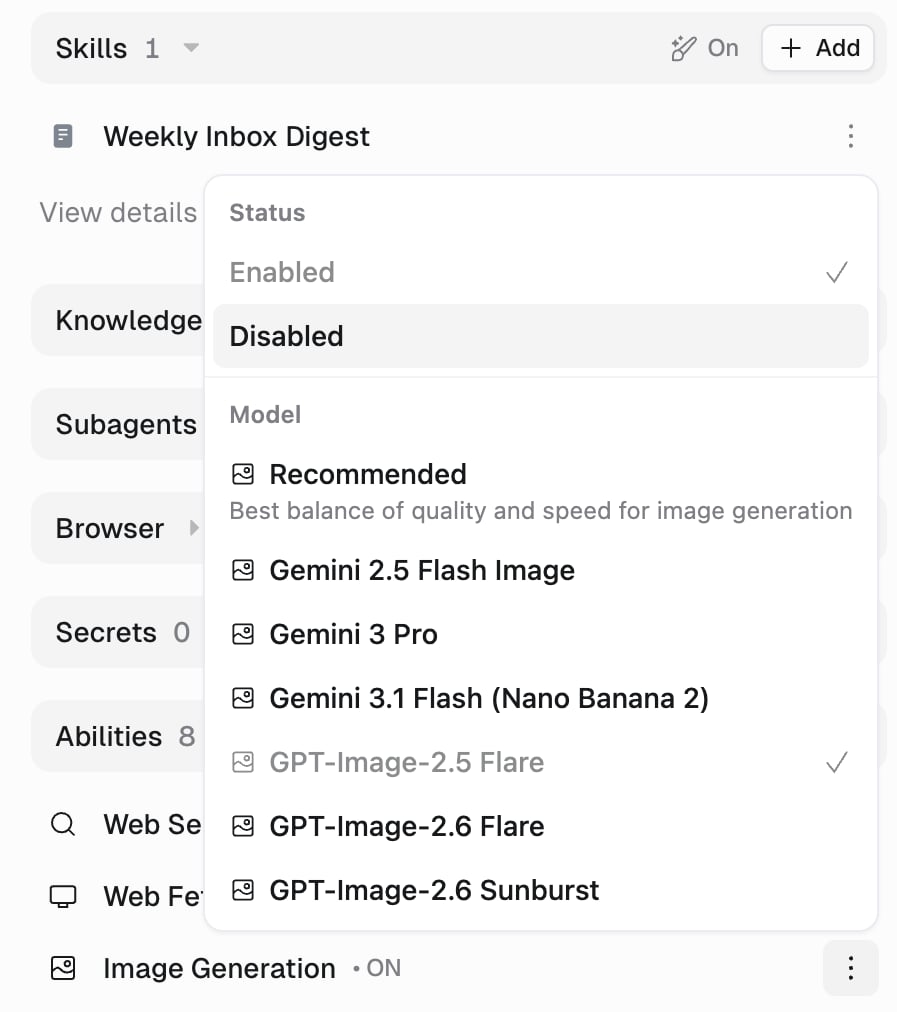
Recommended uses a fallback chain starting with GPT-Image 2.6 Flare and GPT-Image 2.6 Sunburst. It skips models your organization restricts.
GPT-Image 2.6 Flare and Sunburst can also create animated GIFs. Ask for an animation in your prompt; the agent chooses the frame count, timing, and GIF size.
Per-request options
The agent selects these options for each image request:
Agents can also pass reference images to edit them or keep a subject, product, or style consistent. OpenAI image models accept up to 16 reference images. Gemini 3.1 Flash and Gemini 3 Pro accept up to 14, and Gemini 2.5 Flash Image accepts up to 3. OpenAI accepts JPEG, PNG, and WebP; all Gemini image models also accept HEIC and HEIF.
What it costs: Image generation is charged from the usage reported by the image model. Cost depends on the model and the options selected, so higher quality or resolution costs more credits. See Credits for how BYOK affects image generation.
Older image model IDs are no longer in the picker. Requests that use a retired ID are remapped to a current model:
The agent’s computer
Every agent has a built-in computer for running Python and shell commands in a secure, isolated environment. No setup is needed. Saved workspace files carry across tasks. Packages you install last for the current chat; use.workspace/agent/requirements.txt to install them in future chats.
To open a custom agent’s live desktop, click + beside the chat box, then Open desktop. This also works in Gumball. Your role must allow Agent desktop. See Open the desktop for access, incognito, and retry behavior.
Computer & secrets
What the agent’s computer can do, persistence, execution limits, preinstalled packages, and Agent Secrets.
The agent’s browser
Agents can also get a real Chromium browser to open websites, sign in, fill forms, and download files on sites no connector covers. Turn it on from the Browser section of the agent’s configuration, watch it live from the chat, and replay every step afterwards.Agent browser
Turn on the browser, watch it live, answer handoffs, logins, browser profiles, and 1Password.
Measuring and improving an agent
Open + (New tab) in the right panel to see Performance, Evaluations, and Reflections. Evaluations grade completed tasks against your criteria. Reflections have the agent review past tasks and suggest improvements you can accept or dismiss.Agent performance
Insights, Evaluations, and Tasks for a single agent.
Evaluations
Define criteria and grade the agent’s answers so you catch regressions early.
Reflections
Let the agent review its own recent tasks and propose improvements.
Working in a task
Message input menu
The + menu in the message bar gives you quick actions while you work: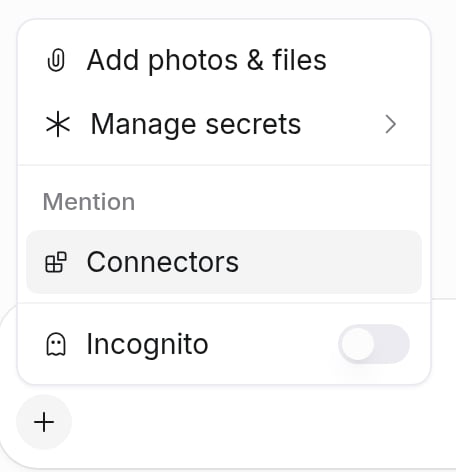
- Add photos & files: attach files and images to your message.
- Manage secrets: add or pick the secrets this agent can use on its computer.
- Mention: reference something by name in your message, such as Connectors, Skills, Secrets, or other Agents. Only the kinds this agent has show up.
- Incognito: toggle a private task (covered below).
Voice input
You can send audio instead of typing. Gumloop transcribes it on the server and sends the text to the agent, so the task flows the same whether you type or talk. To dictate, click the microphone button at the right of the message bar. A live waveform appears while you dictate, and your words stream into the draft at the cursor. Select Stop dictation to finish or press Escape to cancel. The agent receives the text, not the recording.- Models: dictation uses OpenAI’s GPT Live Transcribe first. If OpenAI is unavailable or your organization’s model access doesn’t allow it, Gumloop uses Grok instead.
- Length: one dictation can run for up to 10 minutes. At the limit, Gumloop stops and keeps the final transcript.
- Cost: dictation uses credits for the audio transcribed. See Credits.

Export a table from a reply
When an agent’s reply includes a table, use the copy and download icons below the table to copy it as CSV or download it astable.csv.
Message queue and steering
You do not have to wait for the agent to finish before sending your next message. On desktop, while the agent is working, press Enter to add a follow-up to the message queue without interrupting its current step. You can edit, reorder, or remove a queued message before it is delivered. If someone else sends a message while the agent is working, their message doesn’t join the current run. The agent finishes first, then starts a new run in the same task for that person, using their permissions, connector accounts, and credits.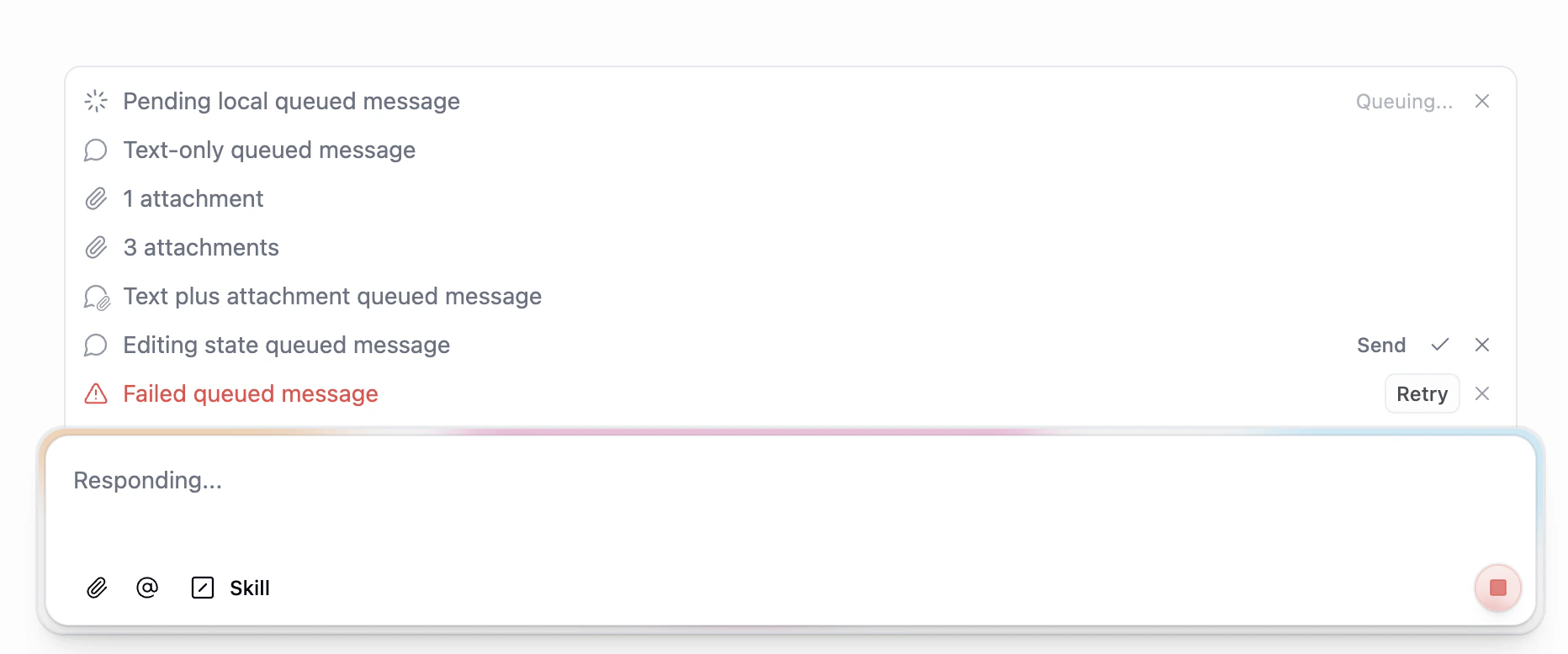
See who else is here
When other people have the same task, agent, file, or skill open, their avatars appear in its header (up to three, then +N). Hover an avatar to see their name. People who have gone idle look faded and show (Idle) after their name. In a task, a Typing pill next to the message box shows when someone else is writing a message. Expand it to preview what they’re typing.Context usage meter
The circular meter in the bottom-right of the message input shows how much of the agent’s usable context budget is in use, including any smaller context window you selected. Hover the meter for a breakdown across System, AI Instructions, Abilities, Tools, Skills, Subagents, and Conversation.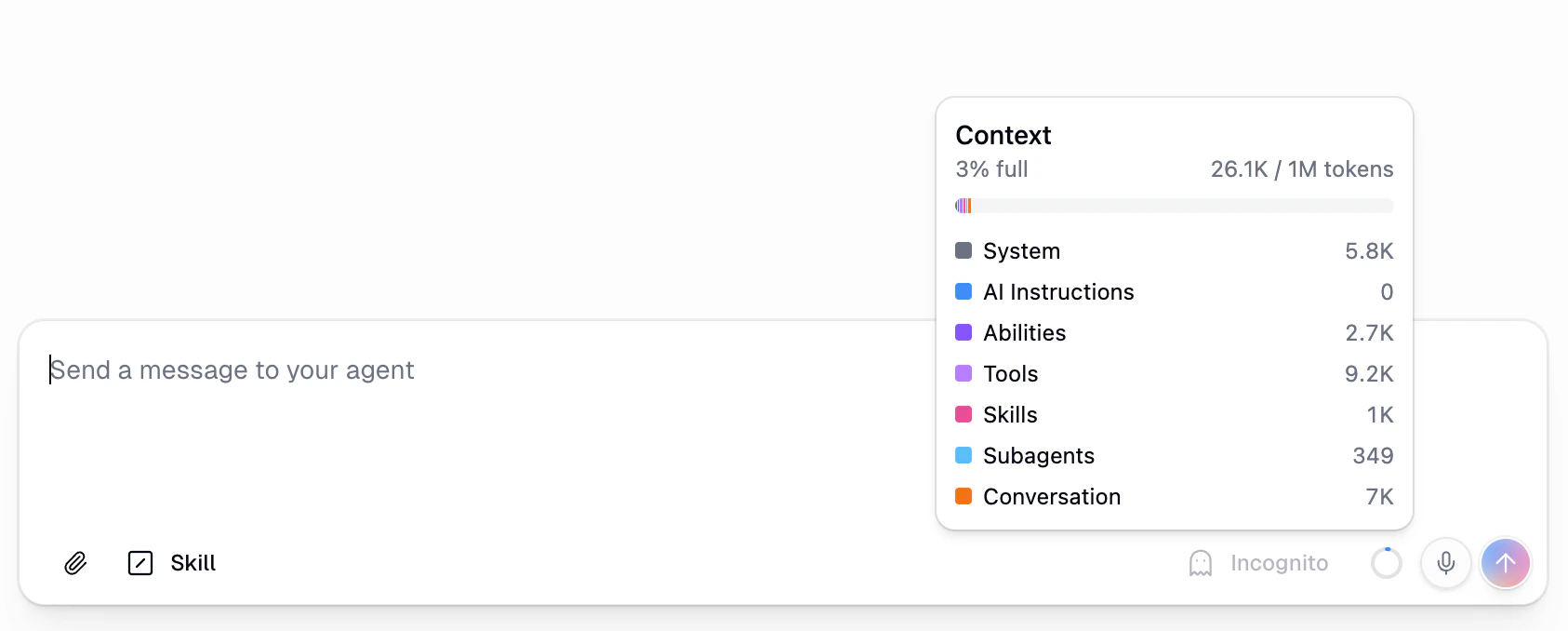
Incognito mode
Incognito keeps messages in a temporary cache with a 24-hour expiry that refreshes on each write, not a durable transcript in task history. Tasks still count toward analytics and impact reports as Incognito Chat, and creator details such as name and email, usage, and operational records can remain. Incognito does not anonymize the creator or remove all stored data. See the Privacy Policy for full details. For a single task, toggle Incognito from the message input menu before sending. Existing tasks keep their original mode, and incognito tasks pass their mode to subagents. Enterprise organizations can require incognito for every new task on an agent. See Custom roles for Always run incognito and its permissions.Understanding credit costs
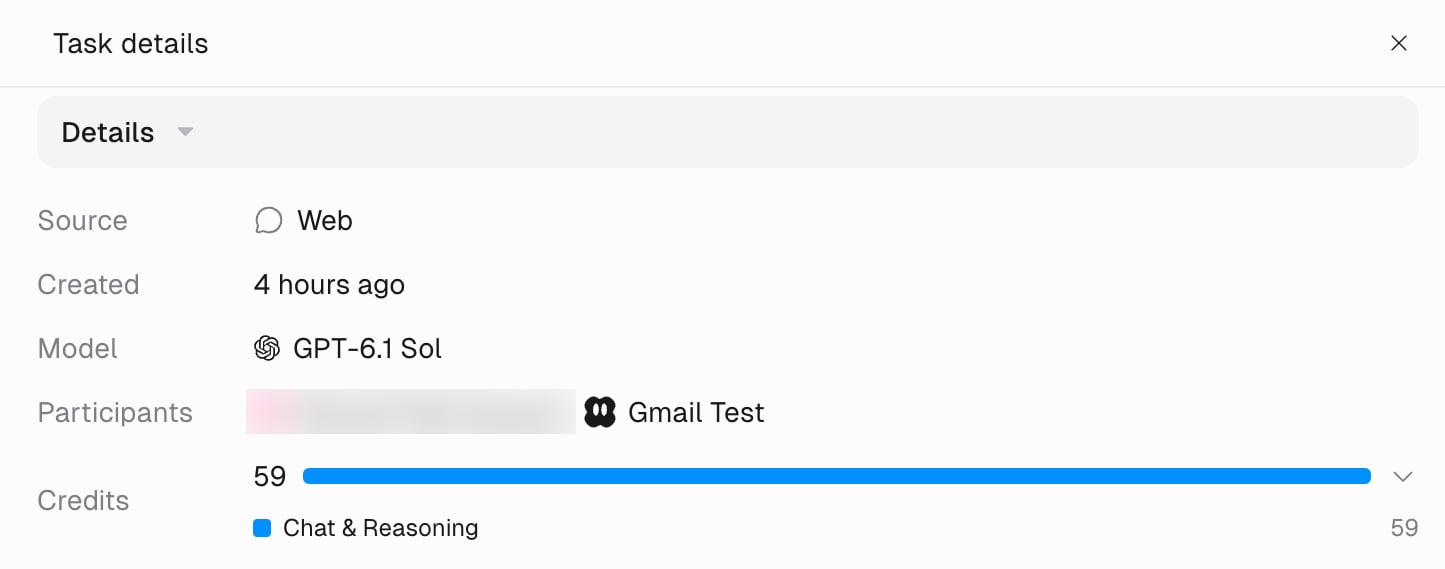
Agents consume credits for AI model usage, tool calls, the compute time they spend working, and an orchestration fee on top of those. Cost depends on the model, message length, task history, and the number of tools available. Click the task title in the chat header to see Credits, Source, Model (or Models), and Participants. Open Credits for a breakdown when available.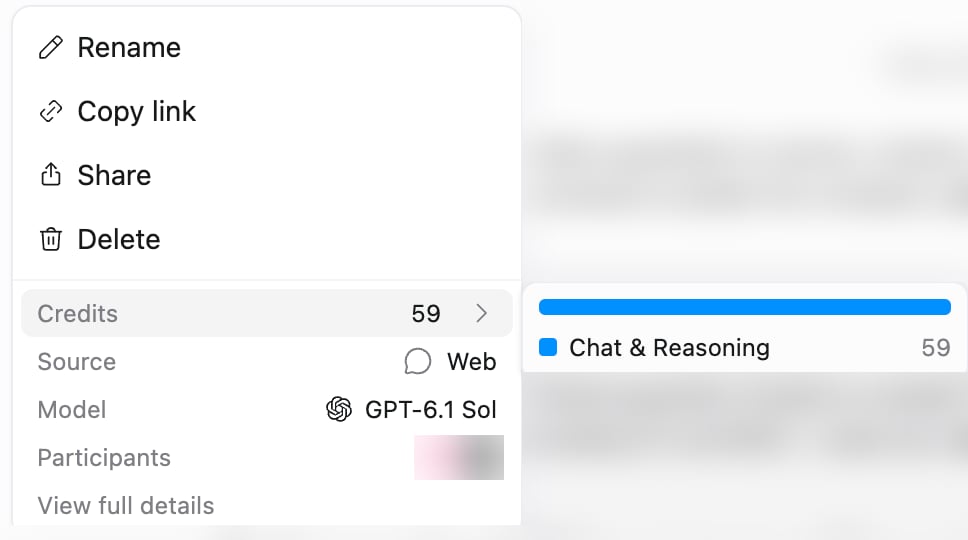
Credits
Full model pricing, integration costs, and how to track usage.
Channels
Open Channels from + (New tab) in the agent’s right panel to make your agent reachable outside Gumloop.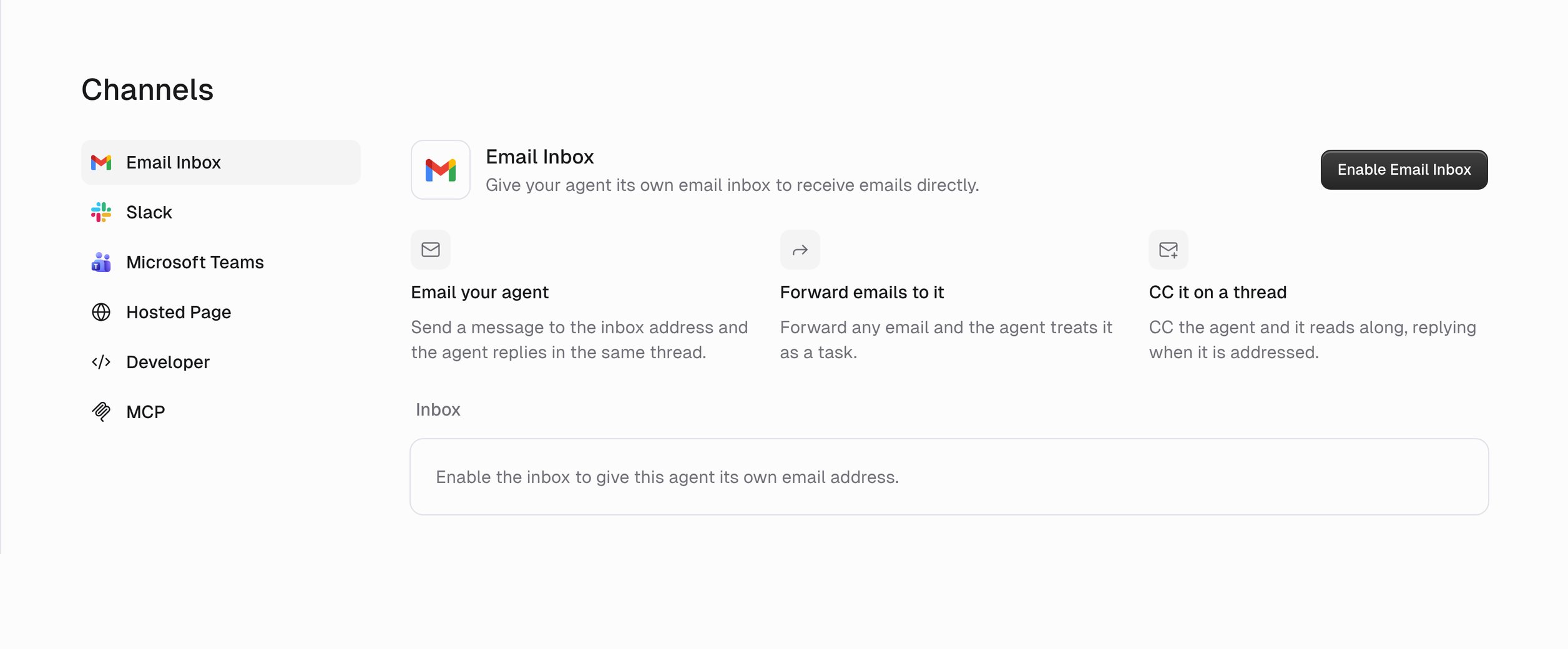
Slack
Deploy agents to Slack channels for team-wide access.
Microsoft Teams
Deploy agents to Microsoft Teams channels.
Give your agent an inbox it can read and reply from.
Hosted pages
Share a public or private hosted page for your agent.
Customize the sidebar
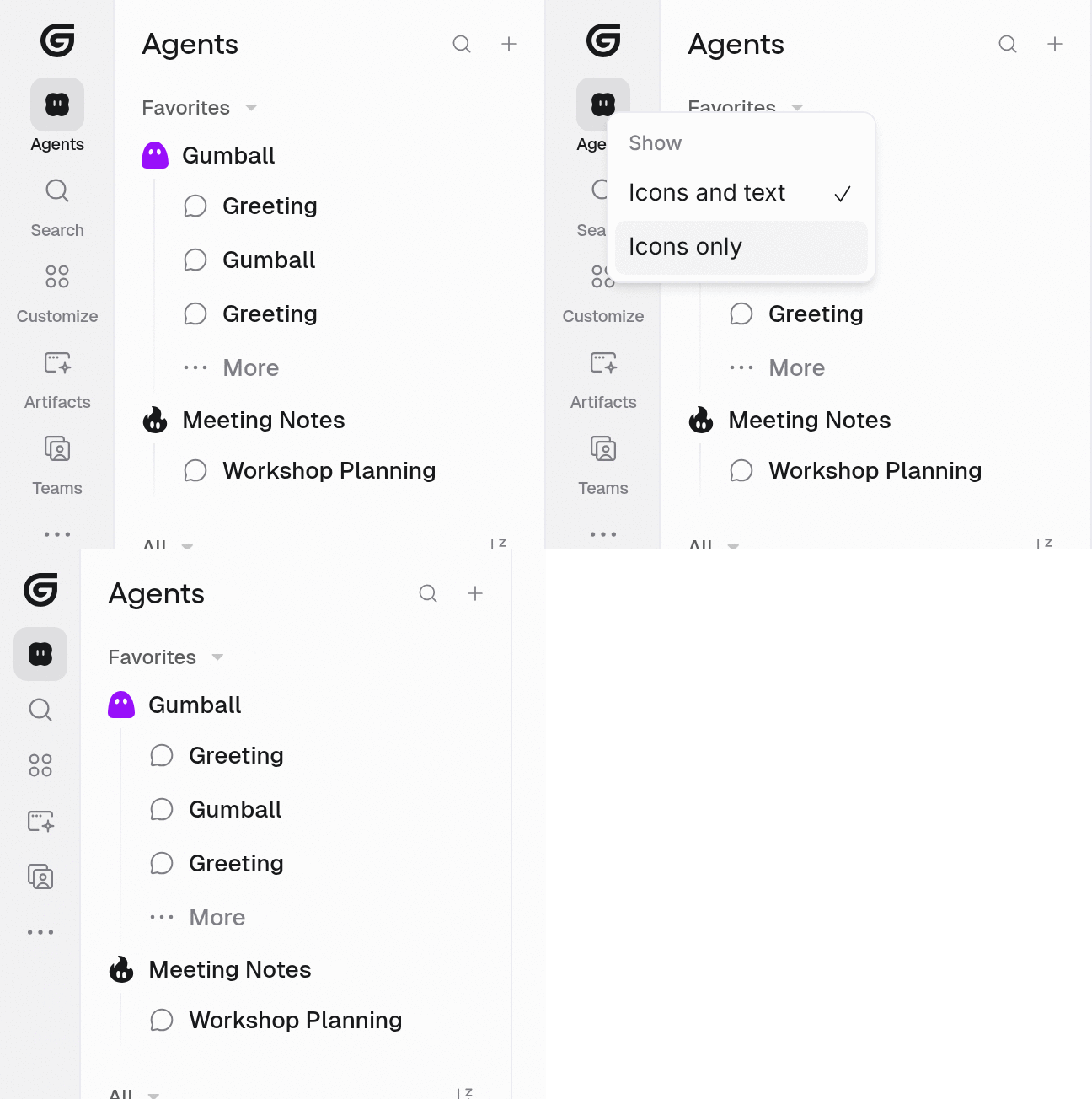
Use More in the sidebar to find pages and teams. Hover over a team, a Customize section, or a Settings page and click Pin to sidebar to keep it in the rail. Drag your pins to reorder them. To remove one, right-click it and choose Unpin from sidebar.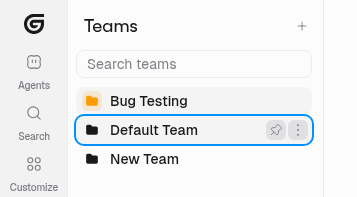
Usage stats
A line under the agent’s description summarises how it has been used over the last 31 days: how many tasks it worked on, and on a team agent, who used it most (Used by Ana, Ben and 4 others · 62 tasks in the last month, with avatars for the top users). A personal agent reads Worked on 62 tasks in the last month.Stats respect Task Visibility. If you can only see your own tasks on an agent, the numbers cover just your usage and no users are named. Subagent runs are excluded. Incognito tasks count toward usage but do not provide a durable transcript in task history.
Managing tasks
Open the Tasks page from the bottom of the Agents panel to find work across agents. Search by task name, or narrow the list with Date, Source, Agent, Status, and Show. Source choices depend on the tasks you can access, for example Web and Triggered by Schedule. The default list includes tasks started through the API. Show switches between All and Unread. Each row shows the task’s agent, source, credits used, status, and last activity.
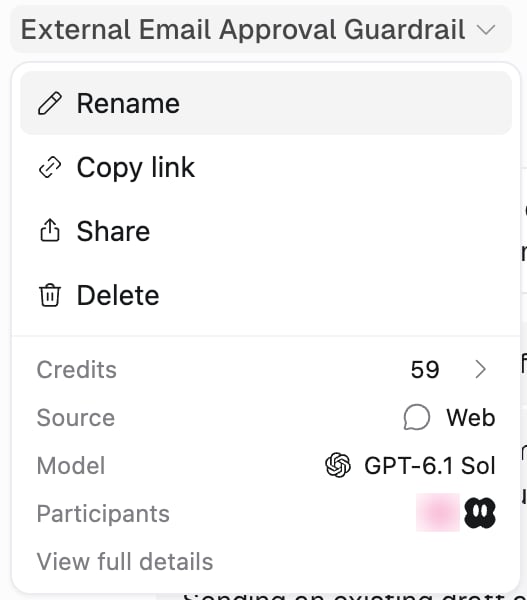
The same menu shows Credits, Source, Model (or Models), and Participants. Open Credits for its breakdown when available. View full details opens the task’s details panel when available.
When you search an agent’s chat history, matches appear under Search results. Matching message text appears below the task title when available.
Links to a custom agent or workflow with prompt text in
?prompt= fill in the message box instead of sending the message. Review or edit the text, then send it when you’re ready. Gumball chat links with ?prompt= send the prompt automatically.
Workflows are available if you or one of your teams ran a workflow since November 2, 2026, or you or one of your teams owns an active recurring trigger. Organization admins whose members or teams qualify can open workflows from links but cannot list them unless they qualify themselves. Otherwise, Gumloop shows “Workflows are turned off for your account. Contact Gumloop support if you still need them.”
How do I delete an agent?
Owners can delete an agent from either location.- The agent’s Settings tab, in the Destructive section.
- The agent’s ⋮ menu on the Agents page, or on its favorite in the sidebar.
- Who has access to the agent.
- Channels it disconnects: Slack channels, custom Slack apps, Microsoft Teams, email, iMessage, and hosted pages.
- Its active triggers, including ones other people created.
- Agents that use it as a subagent.
- Agent registries it’s removed from.
Guardrails
For agents that take real actions, layer on guardrails so they stay within bounds. Open the agent’s Agent tab. Under Guardrails, click + Add. In Add guardrail, choose what it applies to, describe the action in When the agent wants to, and choose an action under The agent should: Ask for approval, Block, Tag, or Run without approval. Click Add guardrail, then review the agent’s proposal. See the step-by-step guide.Human in the Loop
Make the agent pause for approval before write, delete, and other sensitive tool calls.
Guardrails
Set conditions that block or flag specific tool calls at the agent or organization level.
Attach photos
You can attach HEIC photos for an agent to read and preview in the browser. Gumloop converts them for use. The model doesn’t need native HEIC support. On mobile, Enter adds a new line. Use the send button to send your message.Review credentials before saving
1
Save your text in the editor
When you save agent instructions, a trigger prompt, or edited skill text, Gumloop checks for credentials such as API keys and private keys.
2
Review any findings
If it finds a possible credential, the Review credentials dialog shows the finding and its location. Values start hidden. You can reveal one to check it.
3
Go back or save anyway
In Review credentials, choose the edit button for the text you’re saving:
Remove the credential in the editor, or choose Save anyway to continue with it. The warning doesn’t remove or revoke the credential for you.
Does every API save get this review?
Does every API save get this review?
No. This review runs in Gumloop’s editors. Don’t assume text saved through an API or another tool gets the same review.
Self-improving instructions
Your agent can update its own instructions while it works. Correct it once (“always check Salesforce first,” “keep emails under 100 words”) and it edits its instructions so the same mistake does not happen again. Changes take effect on the next step and persist across future tasks. The toggle sits below the system prompt editor and is on by default; there is no version history, so revert by editing the prompt manually.Can an agent change the rest of its own setup?
Yes. With Edit Own Instructions on, you can ask a custom agent in chat to change its own configuration, for example “Turn on image generation” or “Add the Notion connector and use it for meeting notes.” The agent can change its model, connectors, skills, knowledge sources, subagents, abilities, and settings. It can also create scheduled and webhook triggers, and pause, resume, or reword its existing triggers.- Every change needs your approval. The agent shows an approval card that lists each change. The card never offers Don’t ask again for this tool, whatever the agent’s approval settings are.
- You need permission to edit the agent. The agent makes the change as you, so the same access rules and organization restrictions apply as when you edit the agent yourself.
- Changes apply from your next message, not partway through the current turn.
- Only where someone can approve. The agent can’t change itself in runs nobody is watching, such as trigger runs, or in Microsoft Teams, email, and iMessage, where nobody can answer an approval card.
AI advanced settings
Most agents never need this. Defaults are already set for a good balance of performance, cost, and reliability. Organization admins can set the defaults that new agents inherit. See Agent Default Settings. Open the Settings tab, then expand Advanced AI, Task Summarization, or Model Fallback. Model-specific Reasoning, Speed, and Context window controls are in the Agent tab’s Model dropdown, and appear only when the selected model supports them. See AI models.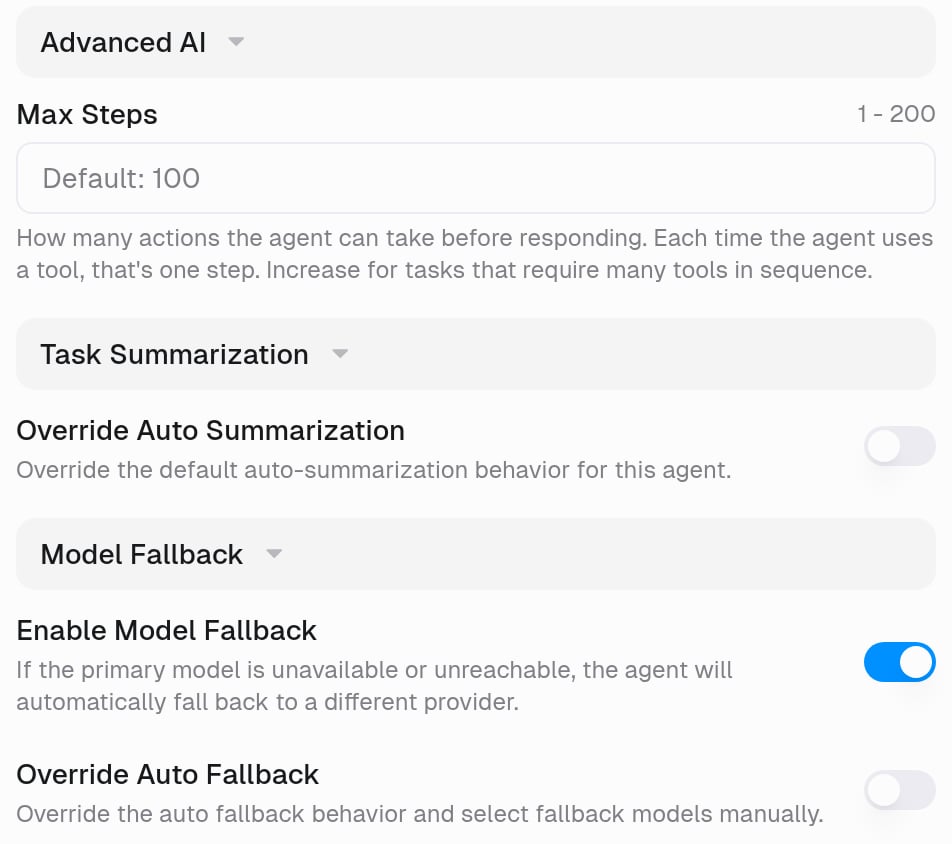
Advanced AI
Advanced AI
Per-provider model parameters. Switching models preserves your preferences for each provider.
Reset Model Parameters to Defaults restores these values for the current provider.
Context window
Context window
Some models ship two context windows. Open the model dropdown in the Agent tab and choose Context window when the selected model supports it.
A smaller window makes summarization start earlier and can reduce cost and latency. Automatic summarization respects your selected window, even if routing or fallback uses a larger model; a smaller active model can reduce it further. See AI models for context windows and Credits for pricing.
Task summarization
Task summarization
When a task gets close to its context budget, Gumloop summarizes older messages into a short recap and keeps recent messages in full. By default, it starts the summary in the background as soon as the agent replies, so it’s usually ready before your next message. If it isn’t ready yet, your next message waits for it.Automatic summarization has a default threshold of 300,000 tokens, or less on smaller context budgets. Choosing a larger context window does not mean the agent keeps all earlier messages in full until that window fills.Turn on Override Auto Summarization to change Summarization Trigger (%), Summary Model, Protected Context Tokens, Max Summary Tokens, and Summarize After Long Turns. A lower trigger summarizes sooner, which can cut the cost of long tasks. A higher trigger keeps more of the full history. Turn off Summarize After Long Turns to wait for your next message before summarizing.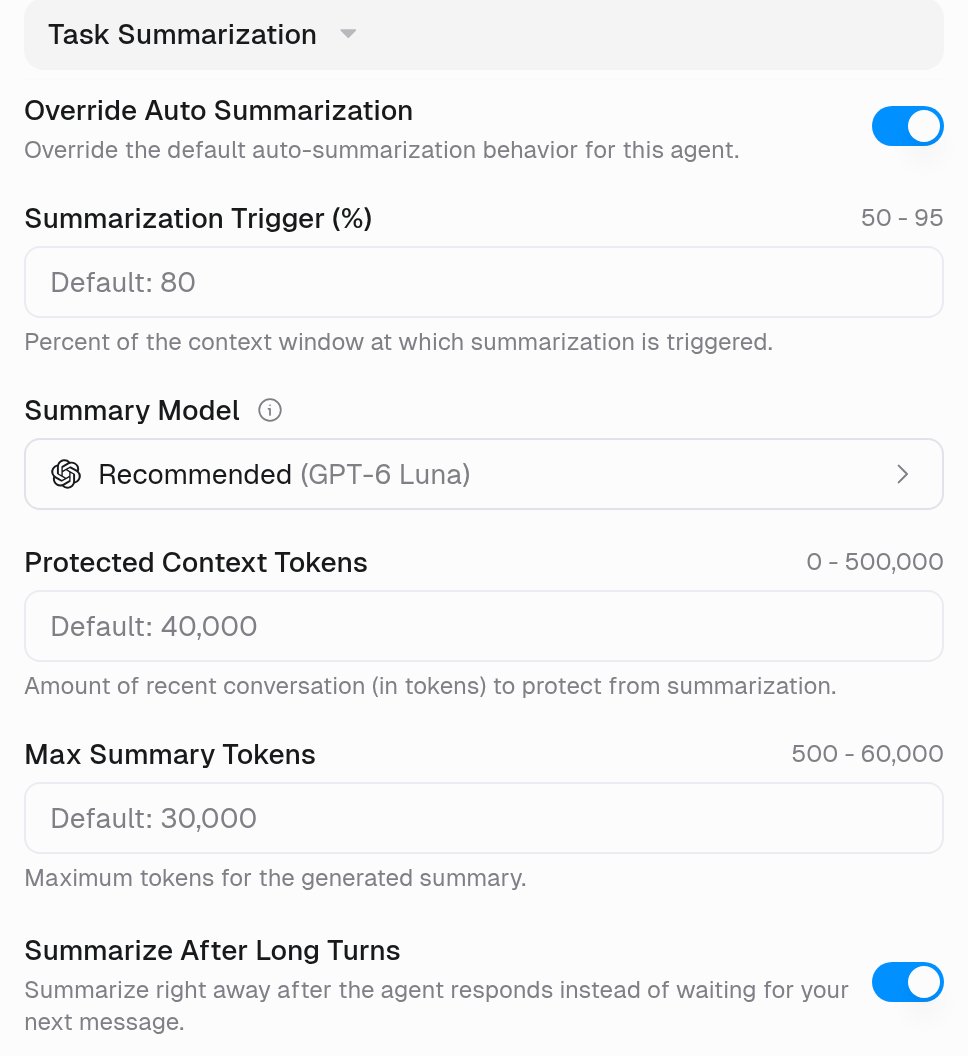
Model fallback
Model fallback
If the primary model is unavailable or unreachable, the agent retries and then switches to a fallback from a different provider. Enable Model Fallback is on by default. Turn on Override Auto Fallback to pick fallback models yourself.
AI models
Browse the full model catalog by tier, vision models, and bring-your-own-key (BYOK).
Best practices and troubleshooting
- Best practices
- Troubleshooting
Start simple, add complexity
Start simple, add complexity
Begin with two or three apps and short instructions. Test, watch how the agent behaves, then add tools and rules based on real usage. Avoid launching with 15 tools and a 2,000-word prompt.
Treat the agent as a work in progress
Treat the agent as a work in progress
When the agent makes a mistake, ask it: “What could I add to your instructions to prevent this?” Then have it update its own instructions or a skill. Review past tasks for patterns.
Set clear boundaries
Set clear boundaries
Be explicit about what the agent should never do without approval: delete records, send emails, make purchases, or modify production data. Back this up with Tool Management approvals.
Next steps
Agent triggers
Run agents automatically on a schedule or in response to events.
Agent skills
Build reusable knowledge packs that teach agents how to do specific work.
Brain
Give agents company knowledge to search from your connected sources.
Evaluations
Grade agent responses and catch regressions before they ship.
Reflections
Let agents review their own work and propose improvements.
Computer & secrets
Run code securely and manage agent secrets.
Agent access
Owners, Users, User Permissions, and Task Visibility.